
From Idea to
App Store: Complete
App Development Process
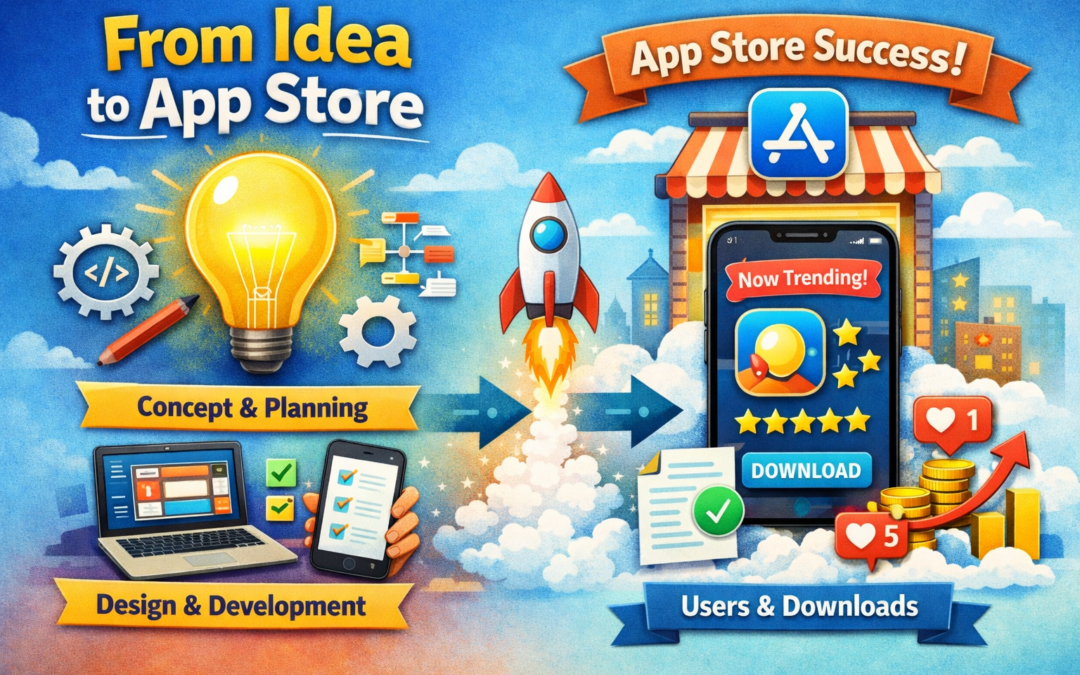
A humanised, expert walkthrough of every stage — from the spark of an idea to a live app millions can download.
Every Great App Started as a Conversation
It usually goes something like this: someone is frustrated with a broken process, a gap in the market, or a problem nobody has properly solved — and they say, “wouldn’t it be great if there was an app for that?” That moment of clarity is where everything begins.
But turning that clarity into an app that actually ships — one that users love, that functions reliably, and that climbs the App Store rankings — requires far more than an idea. It demands a structured, expert-led process. At Impeck LLC, we’ve delivered hundreds of mobile applications across Android, iOS, and cross-platform environments. This guide distils that experience into a clear roadmap anyone can follow.
Why App Development Is More Valuable Than Ever in 2026
The numbers are striking. Mobile app revenue is projected to reach $233 billion by 2026, and the App Store ecosystem alone facilitated over $1.3 trillion in total billings and sales in 2024. That figure represents 152% growth in just five years. The opportunity for businesses — whether startup or enterprise — has never been wider.
Beyond revenue, apps are now how businesses connect with customers at the most personal level — on their devices, in their hands, in their daily routines. Ignoring mobile is no longer a strategy. It’s a vulnerability.
The Complete App Development Journey: 7 Stages
Whether you’re building a consumer app or an enterprise solution, the development lifecycle follows a proven sequence. Skipping stages is the most common — and most expensive — mistake teams make. Here’s how it works when done right.
Ideation & Market Validation
This is where your app’s foundation is poured. You define the core problem your app solves, identify your target users, and validate that enough people care. Tools like SWOT analysis, user interviews, and competitive audits help you refine the concept before a single line of code is written.
What Happens Here
You map out the specific problems users face, review existing apps to find gaps, and draft a value proposition that differentiates your concept. You also outline your initial monetisation strategy — whether subscription, freemium, paid, or in-app purchases.
Key output at this stage
A validated concept document and a shortlist of MVP (Minimum Viable Product) features that solve the core problem without unnecessary complexity.
Planning & Technical Architecture
Once the concept is validated, planning transforms your idea into an actionable blueprint. This stage answers the critical engineering questions: which platform (iOS, Android, or cross-platform with Flutter or React Native?), which tech stack, what APIs are needed, and how will the system scale?
Timeline Benchmarks
Simple apps typically take 2–4 months. Moderate-complexity apps require 4–8 months. Complex, feature-rich applications often need 8–12+ months. Realistic timeline planning here prevents costly deadline pressure later.
Platform decision factors
iOS users typically generate higher per-user revenue and run on fewer device variations, making testing more predictable. Android reaches a broader global audience. Cross-platform tools like Flutter now power a significant share of modern app projects.
UI/UX Design & Prototyping
Design is not decoration — it’s strategy. Research consistently shows that every $1 invested in UX can return substantial value, and a design issue fixed at prototype stage costs far less than fixing it post-launch. Your design process starts with wireframes and evolves into interactive prototypes.
What Great Design Achieves
It makes the app feel obvious to use. Navigation is intuitive, features are discoverable, and the visual language matches your brand. Apple’s Human Interface Guidelines and Google’s Material Design are strong benchmarks for usability.
Accessibility from day one
Building accessibility into design — including screen reader support, proper contrast ratios, and usable tap target sizes — expands your user base and improves store approval readiness.
Development: Frontend, Backend & Integrations
This is where your app comes to life. Frontend development builds everything users see and touch. Backend development creates the server infrastructure, databases, and APIs that power your app’s functionality. The two run in parallel on experienced teams.
Modern Development Approaches
Agile methodology — with iterative sprint cycles — has become the standard because it allows clients to review progress, provide feedback, and adapt requirements without derailing the entire project.
Integration considerations
Payment gateways, social login, mapping services, push notifications, analytics — each integration must be individually tested for reliability and security before being included in the build.
Quality Assurance & Testing
No app should reach users untested. QA testing covers functionality, performance, security, and compatibility across devices, screen sizes, and operating system versions.
What testing includes
Teams verify navigation flows, form validation, load speed, crash points, device responsiveness, and data protection. The goal is to ensure users meet a polished, stable product on day one.
Why this stage matters
Fixing bugs before launch saves money, protects reviews, and reduces the risk of uninstall rates caused by poor first impressions.
Launch: App Store & Google Play Deployment
Launch day is more than uploading files. You prepare screenshots, metadata, keyword-optimised descriptions, privacy details, store categories, and compliance documentation. Then you submit your build to Apple App Store and Google Play.
Launch readiness checklist
Before publishing, the app must be tested in production-like conditions, store assets must be prepared, analytics should be installed, and crash monitoring should be active from day one.
What many teams miss
Store approval guidelines can delay launch if privacy, login flows, or payment features are not documented correctly. A proper launch process reduces that risk.
Growth, Optimisation & Post-Launch Support
Launch is the beginning — not the end. Real app success comes from analysing user behaviour, improving onboarding, releasing updates, fixing issues, and continuously expanding features based on real usage patterns.
What growth teams track
User retention, session duration, feature usage, uninstall rates, crash reports, and funnel drop-offs all help identify where the app should improve next.
Long-term success
The best apps keep evolving. Businesses that treat app development as an ongoing product strategy consistently outperform one-time launch-focused competitors.
Great Apps Are Built with Process, Not Guesswork
You don’t need any technical background — you need clarity on the problem your app solves and who it solves it for. Our team at Impeck LLC handles all the technical architecture, development, and deployment. We keep you informed and in control throughout with regular sprint reviews and plain-English updates, so you always know exactly where your project stands.